Agent Wakeup Latency Requirements for Interactive Products
Wakeup latency is a structural requirement, not a performance tuning detail.

Wakeup latency, the time an agent's runtime takes to go from dormant to ready, is a structural requirement for interactive agent products, not a tuning parameter to optimize after launch. Delay does not feel smooth to a human, where every extra hundred milliseconds costs a little more goodwill. It behaves more like a cliff: below a certain threshold, a response feels immediate; above it, the product feels broken, regardless of how good the underlying model is.
Wakeup Latency as a Structural UX Requirement
A user interacting with an agent does not experience the agent's architecture. A user experiences one wait, start to finish, no matter how many subsystems, models, or tool calls sit behind that wait. If a request takes three seconds because retrieval was slow, or three seconds because the runtime had to boot before it could do anything at all, the user feels the same three seconds either way. The threshold that decides whether a product feels responsive is the one the user feels at the boundary of the whole interaction, not the one any single component happens to clear on its own.
That threshold carries direct business weight for products meant to replace a human channel: a support agent standing in for a phone queue, a research assistant standing in for an analyst, a coding agent standing in for a second engineer. A slow agent does not just annoy the person using it. It pushes that person back toward the channel the agent was supposed to replace, and once that happens the product has failed on its own terms, no matter how accurate its answers are. That is why wakeup latency belongs at the architecture stage of an agent product, not in a post-launch performance review. If the infrastructure cannot wake up fast, no amount of prompt engineering or model choice can close that gap.
How agentic pipelines compound delay across steps
A single LLM call has one number attached to it: time to first token, time to completion, whatever the benchmark of choice happens to be. An agentic turn is a chain: the model reasons about what to do, calls a tool, waits, reasons again, maybe calls a second tool, retrieves context, and only then generates a final answer. Each link in that chain adds its own delay on top of the ones before it, so a turn that touches five steps can take noticeably longer than a single model call would, even when none of those five steps looks slow by itself.
Tool calls make the arithmetic worse than it first appears. A web search, a code execution, a database lookup, each one pauses the model mid-reasoning, hands off to the tool, waits for the result, and re-enters inference once the tool responds. The model keeps occupying VRAM for the full length of that pause, so tool-calling pipelines need more memory headroom than stateless single-turn inference, and every round trip through a tool is its own discrete latency event stacked on the ones before it.
Multi-agent orchestration multiplies the problem, since when a coordinator fans a single user query out across several agents, each one running its own retrieval or tool calls, the delay compounds across agents as well as across steps inside any one agent. A routine query can touch two or three knowledge sources through a retrieval-augmented pipeline, and that alone can rack up hundreds of milliseconds of routing and retrieval overhead before a single token of the actual answer appears.
Session length adds a third dimension, and this one worsens over time. As a multi-turn conversation grows, the key-value cache attached to it grows too, and when the cache gets larger, prefill time on every subsequent turn gets longer. A system sized only for the model's base footprint, without accounting for how long real conversations run, will start fast and get slower the longer a user stays engaged, which is close to the opposite of what a good interactive product should do.
None of this can be solved by optimizing any one stage in isolation. A pipeline can have a fast retrieval step, a fast tool call, and a fast generation step, and still feel sluggish to the user because the sum of those fast parts is slow. The only way to find out where the real bottleneck sits is to measure latency at each stage separately, p50, p95, and p99, rather than relying on one end-to-end average that hides which step degrades first under load. Given that, the runtime cost of simply waking the agent up before any of this pipeline work can start has to be close to zero. Any amount of boot time at the front of the chain is added directly onto a budget that pipeline steps are already consuming fast.
Cold Boots and the Compound-Latency Problem at the Infrastructure Layer
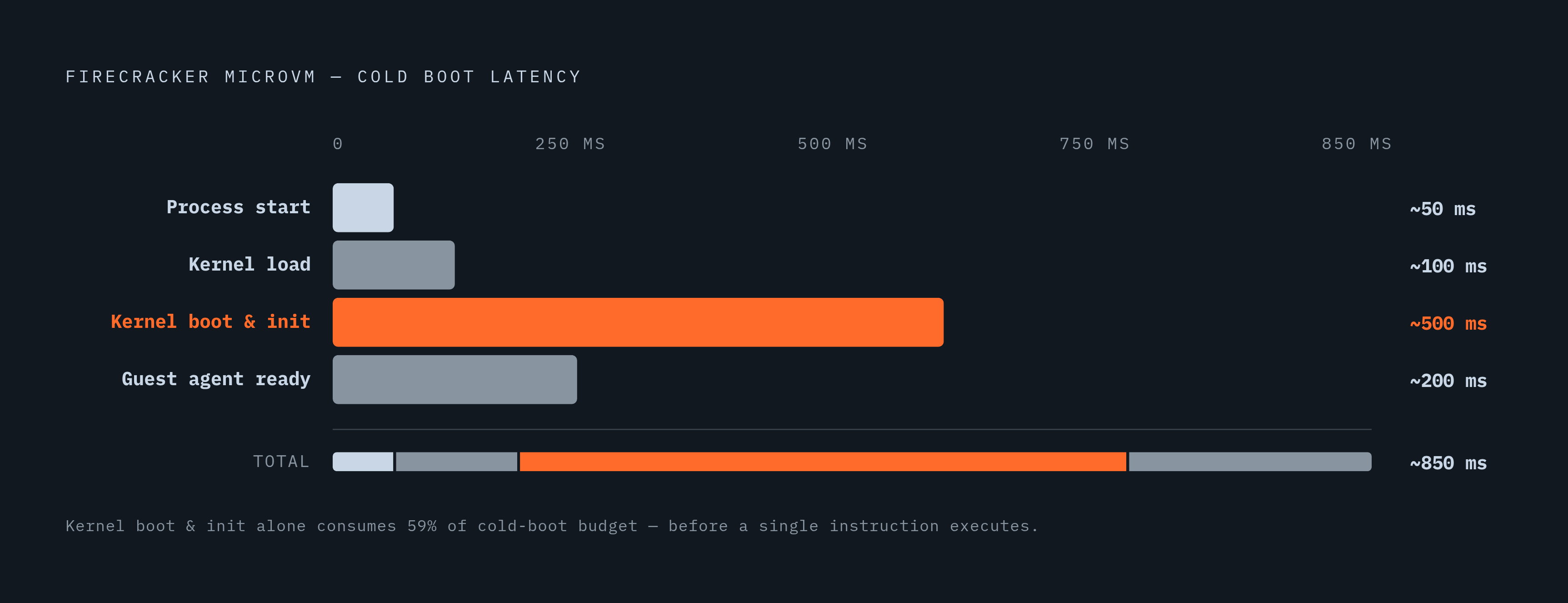
A cold boot spends the latency budget before the agent has done a single unit of useful work, which is what makes cold-start infrastructure structurally unfit for interactive agent products. Firecracker microVMs, a common building block for isolated compute, show exactly where that time goes. Process start takes about 50 milliseconds, kernel load about 100 milliseconds, kernel boot and init about 500 milliseconds, and the guest agent ready signal about 200 milliseconds. Added together, that is roughly one second spent before the agent executes its first instruction.
One second alone already sits close to where you start to perceive a response as slow. Once that second gets stacked underneath the kind of multi-step pipeline described above, retrieval, tool calls, reasoning, generation, the combined total lands reliably past what an interactive user will put up with.
The model side of a cold start is no kinder. The agent's language model has to be loaded into VRAM before a request can be served at all, and loading that model fresh, especially from object storage without any local caching, takes longer still. A live agent loop cannot wait on that kind of load on every request. The model needs to already be resident and ready, since loading it cold would reintroduce the delay an interactive product is built to avoid.
Multi-turn sessions compound the waste further. Full re-initialization on every turn, reinstalling packages, rebuilding filesystem state, reconstructing context that already existed a moment earlier, throws away hundreds of milliseconds of setup work that the system already paid for on the prior turn. Serverless function architectures run into the same wall from a different direction: they trade away infrastructure complexity in exchange for a cold-start penalty that lands squarely on the user's perceived response time.
None of this points toward a faster boot sequence as the fix. The industry's answer has been to remove the boot from the critical path entirely, for every turn after the first one.
Snapshot-Restore and the Per-Turn Critical Path
Snapshot-restore reframes the question. Instead of asking how fast a system can boot, it asks how fast a system can resume from a state it already reached once, and the restore number is an order of magnitude smaller than even a well-optimized cold boot.
The mechanism is straightforward. A microVM boots once, and at some convenient point a full snapshot of its memory and CPU state gets captured to disk. Every subsequent request restores that snapshot instead of booting fresh, so the agent wakes up mid-execution, with its model loaded, its environment configured, and its context intact.
The numbers make clear why this matters. A cold Firecracker boot runs in the range of 125 to 200 milliseconds just for the VM layer, before accounting for kernel init and guest agent readiness on top of that. Restoring from a pre-baked snapshot drops that figure to a fraction of itself, so you reclaim most of the boot budget before the agent's actual pipeline work even begins.
That shift changes what the cold-boot cost represents. So instead of a tax paid on every interaction, it becomes a one-time setup cost on an agent template, paid once and amortized across every session that template serves afterward. For sessions that span multiple turns, the benefit compounds: installed packages, written files, and intermediate outputs accumulated across earlier turns persist inside the snapshot itself, so the agent picks up exactly where the last turn left off instead of re-initializing a clean environment every time someone sends a new message.
This is where snapshot-restore infrastructure, which wakes an agent from a saved state rather than booting from scratch, becomes the only approach that actually works for this problem: it removes the cold-boot cost from the equation entirely, bringing a paused agent back to ready in under a second and leaving the rest of the latency budget for the pipeline's real work. Wake times in this range, sub-second and often down to tens of milliseconds, keep the runtime's own contribution small enough that the variables a developer actually controls, retrieval quality, tool latency, generation speed, become the dominant factors in total latency again, rather than infrastructure overhead dominating everything else.
Micro-VM Isolation as the Right Primitive for Per-User Agent Deployment
A per-user agent, one persistent, isolated runtime assigned to each individual user, is what makes interactive agent products work at the architecture level, and micro-VMs are the execution environment that satisfies everything that model demands at once.
Each user's agent needs its own filesystem, its own installed packages, its own credentials, and its own memory of prior sessions. Shared containers and serverless functions cannot hold onto any of that without rebuilding it from scratch on every invocation, which brings back the exact initialization cost and latency that snapshot-restore was built to remove. A developer who wants an agent to install a software package once and have it still be there a week later needs a persistent environment, not a stateless one that gets rebuilt every time a user sends a message.
Micro-VM isolation delivers that persistence with a hardware-level separation that container-based approaches don't offer. Each instance runs its own kernel, so two agents share no guest-kernel code paths, and the host only interacts with each guest through KVM's narrow, audited interface. Isolation and performance turn out to be the same property here rather than a tradeoff: the boundary that keeps one user's agent from touching another user's data is the same boundary that lets each agent run independently without contending for the other's resources.
This pattern already runs in production, and not just in a single vendor's marketing claims. Amazon Bedrock AgentCore Runtime uses Firecracker to run AI agent tools in isolated environments on a per-session basis, with each session carrying its own persistent filesystem so agents can read and write session-scoped files and preserve state across multi-step interactions. A single 36-core server can produce roughly 180 new microVMs per second, a density that makes assigning a dedicated VM to every individual user workable at fleet scale.
An agent that installs packages, runs browser sessions, or executes arbitrary code on a user's behalf needs a real kernel boundary underneath it, since a process-level sandbox trusts the host's kernel to do all the isolating. Understanding these compounding delays also shows why agent infrastructure cannot be a shared or stateless resource: each agent needs its own persistent state, cached models, session context, credentials, ready to resume the moment a request arrives, which is an argument for dedicated micro-VM isolation over container sharing or function-based coldness.
How idle-cost economics determine whether per-user agents are deployable at scale
Giving every user a dedicated, persistent VM sounds expensive, but look at the actual duty cycle of an agent workload and that changes. Agent trajectories spend most of their time waiting, on a model call, on a tool response, on the user's next message, so the cost question that actually matters is what that idle time costs, not what the active compute costs.
Always-on VMs billed by the second charge for every one of those idle seconds as though the agent were doing real work the whole time. That billing model makes per-user persistence expensive in a way that has nothing to do with how much computation actually happened. Snapshot-restore scheduling changes the shape of that bill: an idle agent gets snapshotted to disk, and a sleeping agent pays storage rates instead of compute rates, which run orders of magnitude cheaper.
Latency has to be a constraint chosen at the infrastructure layer rather than tuned after the fact, and that is why platforms built around persistent, isolated VMs with sub-second wake times end up as the natural fit for latency-sensitive agent products. Maritime, for instance, builds its infrastructure around the idea that agents need to sleep and wake in roughly a second, and that shapes decisions from per-agent VM isolation down to how its scheduler handles snapshot-restore. The pool-sizing math that makes this practical is tractable: at low p99 restore latency, a modest pool of pre-restored sandboxes can absorb bursty demand without any user hitting a cold start under load.
The outcome of getting this right is that per-user agent deployment stops being an enterprise luxury reserved for teams who can afford to keep thousands of VMs running around the clock. Once idle cost approaches storage cost, giving every user a persistent agent of their own becomes a pricing decision, not an infrastructure constraint, and that opens the model up to products built by much smaller teams.
Validating Infrastructure for Interactive Agent Products
If you choose infrastructure for an interactive agent product, you need to test candidates against the specific properties this argument has laid out, not against general-purpose cloud compute benchmarks that say nothing about agent workloads.
Persistence across turns needs to be verified directly: filesystem state, installed packages, credentials, and in-progress work all need to survive a sleep-and-restore cycle without triggering a re-initialization that eats into the latency budget a user actually notices. A developer should be able to put an agent to sleep mid-task, wake it a day later, and find the same files, the same logged-in sessions, and the same partial progress still in place.
Isolation needs to reach down to the kernel level for any agent that executes arbitrary code, manages credentials, or runs browser sessions on a user's behalf. A process-level sandbox is not the same guarantee as a separate kernel per instance, and the difference matters as soon as one agent's workload could plausibly interfere with another's.
Wake time needs an actual number attached to it, measured at p50, p95, and p99, not just advertised as fast in general terms. If a restore averages well but occasionally spikes past a second under load, it will still produce the exact user-facing failure this argument has been describing.
Idle cost needs to be priced out before committing to a platform, because a system that charges wall-clock compute rates for idle time will make per-user persistence unaffordable at any real scale, no matter how good its latency numbers look while active. The infrastructure that passes all four checks, fast wake, true persistence, kernel-level isolation, and storage-rate idle cost, is the infrastructure that lets an interactive agent product behave the way users already expect software to behave: present, responsive, and ready the instant it's needed.