Agent Memory Architecture Beyond Vector Databases
Agents need memory systems that track truth and relationships, not just retrieve similarity.
Vector databases became the default memory layer for agents because they solved a real and immediate problem: injecting relevant context into an LLM prompt at query time. For a team building its first agent, that was the rational first move, not a shortcut taken out of ignorance. Semantic similarity search works. Given a query, it finds the passages, documents, or prior messages that resemble it most closely, and it does that job well enough that early agent demos looked complete the moment retrieval was wired in.
The trouble is that retrieval and memory look identical in a single session. An agent that pulls the right document out of a vector store appears to "remember" it, and nobody watching the demo can tell whether the system retained a fact or merely searched a static index for something that happened to match. Atlan's 2026 architecture guide draws the line precisely: a vector database answers "what is similar?" An agent memory system answers "what does this agent know, and is it still true?" Those are different questions, and a system built to answer the first one has no mechanism for answering the second.
That gap stays invisible in a demo because nothing forces it into view. Nothing expires, nothing contradicts anything else, and no other agent is writing to the same store at the same time. Production usage removes all three of those comforts, and three failure modes accumulate once it does. Retrieval latency compounds, since vector search runs before the embedding step, reranking, and the LLM call itself, and all three costs stack on top of each other rather than substituting for one another. Corpus growth works against query speed too: as ingestion rates climb, the index has to traverse more deeply and weigh larger candidate sets just to return the same quality of match. And consistency breaks down outright when concurrent agents touch the same data, because similarity search carries no transactional guarantee, so one agent can update a customer record while another is mid-decision on the same information with no mechanism to detect the conflict.
None of this makes the original choice a mistake in the way that word usually implies. It reflects the fact that semantic search was the tool at hand, and it did the one job anyone had asked it to do. The cost only appears once an agent has to hold a session together over days, coordinate with other agents, or work against data that changes underneath it. At that point, the tool that solved retrieval has to be evaluated against a different standard entirely: one built around retention, not recall.
Memory for an agent as a lifecycle of acquiring, updating, and forgetting
Memory for an agent is a lifecycle: information gets acquired, updated as circumstances change, and eventually forgotten when it stops being true or useful. A storage system that only handles writing something in and reading it back out covers two moments in that lifecycle and skips the rest. The Agentic Context Management paper, published on arXiv, states the diagnosis directly: production agents fail because they cannot manage what sits in their reasoning context, and the "memory as a store" framing optimizes only the write and the read while leaving everything else unmanaged.
The lifecycle that paper proposes fills in what "everything else" means in practice. An agent must decide what to remember, extract and structure that information, route it to the storage type suited to what kind of data it is, consolidate related facts over time, forget what has gone stale while preserving a record of where a fact came from, anticipate what it will need before it needs it, and compact what it retains to fit inside a fixed token budget. Each of those is a distinct operation, and a vector index performs none of them on its own.
The case for treating memory this way is economic as well as architectural. It is economic. Naïve context accumulation, where every turn of an agent's history simply gets appended to what came before, grows token cost quadratically as a conversation lengthens. Crude summarization brings that cost back down to linear, but it does so by introducing an accuracy cliff, where compressed history quietly drops or distorts facts the agent later needs. Only validated compaction, the kind the lifecycle model calls for, achieves linear cost while preserving fidelity. The lifecycle framing wins on both grounds: it is the only approach that scales in cost and the only one that scales in correctness.
The anti-pattern this produces in practice is concrete rather than hypothetical. An architecture review for a new agent project can walk in with a vector database and a knowledge graph already speced out before the query log holds a single entry, so the retrieval architecture gets chosen before anyone has asked the system a real question. That sequence gets the lifecycle backwards. What an agent needs to remember, and for how long, and on what terms it should forget it, are questions that come before the choice of storage technology, not after.
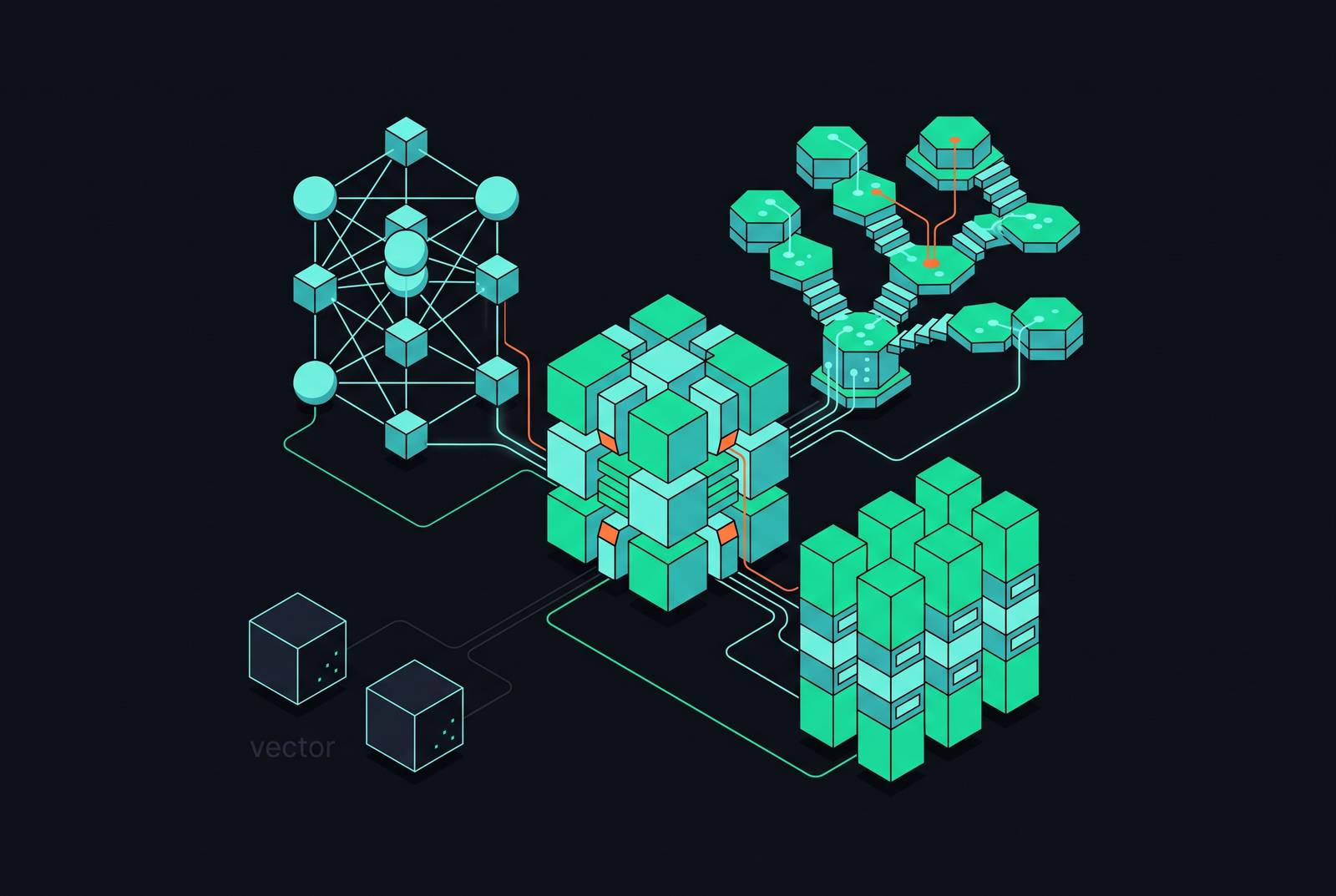
Answering those questions requires distinguishing between the different kinds of things an agent holds in memory, because they don't share a storage contract. Three layers do most of the work: semantic memory, which holds accumulated facts and relationships; state memory, which holds the agent's in-flight working context; and episodic memory, which holds the record of what happened in past interactions. Each demands something different from its underlying store, and each fails in a distinct way when forced into the wrong one.
Semantic memory: why flat vector similarity breaks down when facts have relationships and expiry dates
Semantic memory is the accumulated knowledge an agent holds about entities and how they relate to one another, and flat vector similarity cannot represent that relational structure. A question like "customer X uses product Y, which had incident Z, similar to case W" requires walking a chain of relationships, one entity to the next, and a flat list of embeddings ranked by cosine similarity has no notion of a chain. It returns whatever is closest in vector space to the query, regardless of whether that result sits three relational hops away from the fact the agent actually needs.
The deeper failure is temporal. Two embeddings stored six months apart look equally "similar" to a query if their surface content matches, because a vector store has no staleness flag, no concept of one fact superseding another, and no way to notice that a fact stored today contradicts one stored last quarter. A semantic memory system has to answer not just "what looks like this" but "what is still true," and similarity search was never built to answer the second question.
Production systems handle that freshness problem by pulling the memory layer away from a static index and connecting it to a source that tracks change over time. Atlan frames its Context Agents as the production answer to the "is it still true?" problem specifically: they continuously validate definitions, ownership, and lineage across connectors including Snowflake, Databricks, and dbt, so the memory layer reads from a freshness-tracked source rather than a fixed snapshot.
That need for relational and temporal structure is what pushed graph representations from an experimental idea into a production expectation. Graph memory in AI agents was largely experimental as of 2024, and by 2026 the production pattern had shifted, because memory systems generally moved past pure vector similarity toward built-in entity linking, not because every agent needs a dedicated graph database bolted onto its stack. Mem0's implementation of this idea extracts entities from each memory during the add() step and stores them in a parallel entity collection, folding graph-like structure into the memory system itself rather than depending on an external graph store.
The retrieval pattern that follows from this is multi-signal by design. Rather than ranking candidates on a single similarity score, the retrieval stack runs three scoring passes in parallel, semantic similarity, keyword matching, and entity matching, and fuses the three into a combined score that outperforms any one signal on its own. That fusion combines several scoring methods because no single one captures both what a passage says and how the entities inside it connect to everything else the agent knows, so the system needs more than one signal before it can trust the result.
State memory: why transactional guarantees are a hard requirement, not an engineering nicety
State memory holds an agent's current working context: reasoning still in progress, tool calls that haven't returned yet, partial results, and session-scoped facts that have to stay consistent across simultaneous reads and writes. That is a transactional problem, and treating it as a retrieval problem gets the category wrong from the outset.
Consider two agents touching the same customer risk profile at once, one updating it while the other is mid-decision on the very same record. Resolving that conflict requires isolation guarantees: a way to lock, sequence, or reconcile concurrent writes so that neither agent acts on a version of the record that is about to be overwritten. Approximate nearest-neighbor search offers nothing here. It has no concept of a transaction, no way to detect that two operations are racing against the same piece of state, and no rollback mechanism if one of them should never have completed.
PingCAP's 2026 database guide lays out the pattern that production systems actually use to fill this gap. Redis delivers the ultra-low-latency, in-memory storage suited to session context and transient agent state, while distributed SQL systems such as TiDB, CockroachDB, and Spanner supply the horizontal scalability, strong ACID guarantees, and tenant isolation that concurrent multi-agent state updates require. Those two categories of system exist because they solve a consistency problem, not a similarity problem, and no amount of embedding quality changes that.
The contract state memory needs is close to the inverse of the one semantic memory needs. Semantic memory optimizes for recall accuracy and freshness across a large, slowly changing body of knowledge. State memory optimizes for consistency, low latency, and transactional isolation across a small, rapidly changing working set. A developer who reaches for a vector store to hold an agent's working state has mistaken a fast-moving, tightly coupled problem for a slow-moving, loosely coupled one, and no amount of tuning fixes a mismatch at that level. The third layer, episodic memory, sits between these two and is the one closest to what vector databases were originally built to do well.
Episodic memory: the layer vector databases handle reasonably well
Episodic memory covers the record of what has actually happened: recent conversation history, prior interactions with a given user, and the documents an agent has looked at before. Vector databases handle a meaningful share of this job. Retrieving recent history, surfacing personalization signals, and looking documents up by content similarity are tasks vector search was built for, and a single-session agent working against a fixed, well-governed corpus can run a long way on a vector store alone. The ceiling is not obvious from inside a working demo. It only appears once usage accumulates past the point a demo ever reaches.
Three effects compound once that happens. Appending every interaction to a vector store eventually produces retrieval noise, dilutes the context an agent pulls in response to a query, and drives latency up, and none of those three problems corrects itself, because the store keeps growing by appending unless something is built specifically to consolidate it. A vector index has no built-in notion of which stored interactions still matter and which have been superseded by more recent ones. It just keeps all of them, equally retrievable, forever.
Vectorize's 2026 comparison of agent memory frameworks draws a useful line through this problem: frameworks split between those that handle conversation context and user preferences, which is personalization, and those that handle learned behavior, domain expertise, and accumulated experience, which is institutional memory, and it is the second category that separates a demo agent from one doing real work. An agent deployed on a procurement workflow illustrates the gap concretely. It processes a purchase order, a human corrects it on vendor format and routing rules, and the session ends. On the next run, the agent starts from zero and repeats the same mistake, because raw chat logs are noise rather than structured knowledge, and nothing in the pipeline consolidates that correction into a durable fact the agent can draw on later.
Mem0's State of AI Agent Memory 2026 report identifies temporal reasoning and multi-hop recall as the two categories that most directly test how agents handle real user histories, where facts accumulate and change over time, and these are precisely the categories where flat episodic retrieval degrades most sharply. Episodic memory degrades sharply in temporal reasoning and multi-hop recall for the same lifecycle reason semantic memory does, approached from a different direction. Episodic memory needs consolidation and decay the same way semantic memory needs staleness detection, and a vector store provides neither on its own.
Once semantic, state, and episodic memory are understood as three distinct storage contracts rather than three names for the same problem, engineers have to decide how to compose systems for each job rather than which single database to pick. The choice shifts from picking a single database to composing systems that each handle one of these jobs well, together managing the full lifecycle end to end.
Composing the three memory layers in production
Composition is no longer a theoretical proposal. Standardized benchmarks, LoCoMo, LongMemEval, and BEAM, have moved memory evaluation from self-reported claims to reproducible comparison across genuinely different architectures. Before LoCoMo existed, memory quality was mostly assessed on ad hoc tasks that one lab's results couldn't be checked against another's.
Mem0's April 2026 algorithm illustrates what a composed system achieves once it's measured this way. That pattern, gains concentrated where flat retrieval struggles most, is consistent with the lifecycle argument rather than a coincidence of one product's tuning.
Academic work is pushing on the same problem from a different angle. MemForest, from the National University of Singapore and Zero Gravity Labs, treats agent memory as a write-efficient temporal data management problem and introduces a hierarchical temporal index called MemTree, which organizes memory as time-ordered trees instead of one flat global summary. That structure replaces full-state rewrites with localized updates to individual nodes, and it achieves build rates substantially faster than EverMemOS on both LongMemEval-S and LoCoMo while holding accuracy at a competitive level.
The tradeoff between build rate and accuracy keeps surfacing across this benchmark work, and it has become the central design axis the field now measures against. A system that scores well on accuracy but burns many times more tokens per query isn't viable in production. A system with low latency but poor recall isn't useful regardless of its speed. Measuring across BLEU, F1, LLM judge score, token consumption, and latency together is what stops teams from optimizing one of those axes at the expense of the rest. The ACM paper (arXiv:2607.21503) describes its reference implementation, Maximem Synap, as realizing five primitives, architecting, ingesting, scoping, anticipating, and compacting and consolidation, as a multi-tenant service, and reports high scores on LongMemEval and LoCoMo under its described configuration.
None of this settles the field. Mem0's 2026 report names cross-session identity, temporal abstraction at scale, and memory staleness among the hardest problems still unresolved, alongside application-level evaluation and questions of privacy and consent. What matters for the architectural argument is that all three of those open problems are lifecycle problems, not retrieval problems. Nobody is proposing a better similarity metric to fix cross-session identity. The benchmarks validate an architecture built around acquiring, updating, and forgetting information as three distinct disciplines, not any single vendor's implementation of it, and the hardest problems left on the table are the ones that framing was built to address.
What this architecture requires from the compute layer
A memory system built to this design has infrastructure requirements that follow directly from what it's asked to do. A system that persists state across sessions, keeps a consistent transactional working memory, consolidates episodic records into structured semantic knowledge, and recovers cleanly from interruption mid-task needs an execution environment with durable storage, real isolation, and wake latency measured in a fraction of a second. A multi-layer, stateful, lifecycle-managed memory system has specific compute requirements that stateless serverless functions cannot meet.
The security component follows from what agents are now trusted to do on their own: installing packages, running code, managing credentials. That kind of autonomy needs an environment where a failure or a compromise stays contained. Containers share a host kernel with everything else running on that host, so their isolation lives in the same space the agent's reasoning already lives, userspace, language, logic, rather than being enforced at the hardware boundary. The state continuity component follows from the memory lifecycle itself: persistent disk, a genuine kernel, and the ability to snapshot and restore full execution state, including memory, call stack, and pending continuations, are what make lifecycle-managed memory physically possible rather than a diagram on a whiteboard.
The snapshot-restore model maps onto that lifecycle directly. When an agent is waiting on an LLM response or a tool call, the harness snapshots its execution state to durable storage, compute drops to zero, and the agent resumes from that snapshot the moment a signal arrives. Idle agents pay for storage rather than compute, and that shift is the economic precondition for deploying an agent per user at any real scale. Agentic workloads spend a large share of their execution time in I/O wait, sitting idle while an LLM responds, a tool call returns, or a database query finishes, and the gap between paying for pre-allocated compute and paying under a snapshot-restore model is a structural difference in cost, not a marginal efficiency gain. It's a structural difference in what the workload costs to run.
Firecracker microVMs have become the standard answer to the isolation requirement this creates: a dedicated Linux kernel per sandbox, isolation enforced in hardware, and boot latency measured in milliseconds rather than seconds. Several production implementations show what that standard looks like applied at different points in the stack. AWS Bedrock AgentCore runs one session per microVM, destroyed and sanitized after use, integrated with Bedrock AI services. Purpose-built Firecracker sandboxes for AI agents have reached boot times of roughly 150 milliseconds. Unikraft Cloud, also Firecracker-based, reports sub-10-millisecond cold starts and sub-10-millisecond scale-to-zero, supporting large numbers of isolated instances per server, and is available hosted, as bring-your-own-cloud, or on-prem.
The throughline connects back to where the argument started. Once memory is understood as a lifecycle rather than a lookup, keeping an agent's state alive, isolated, and recoverable for as long as the lifecycle it's managing actually runs becomes the infrastructure task. Maritime, a cloud platform that houses each AI agent in its own persistent Firecracker micro-VM with snapshot-restore scheduling, is one infrastructure option built specifically around that requirement rather than adapted from a stateless compute model.